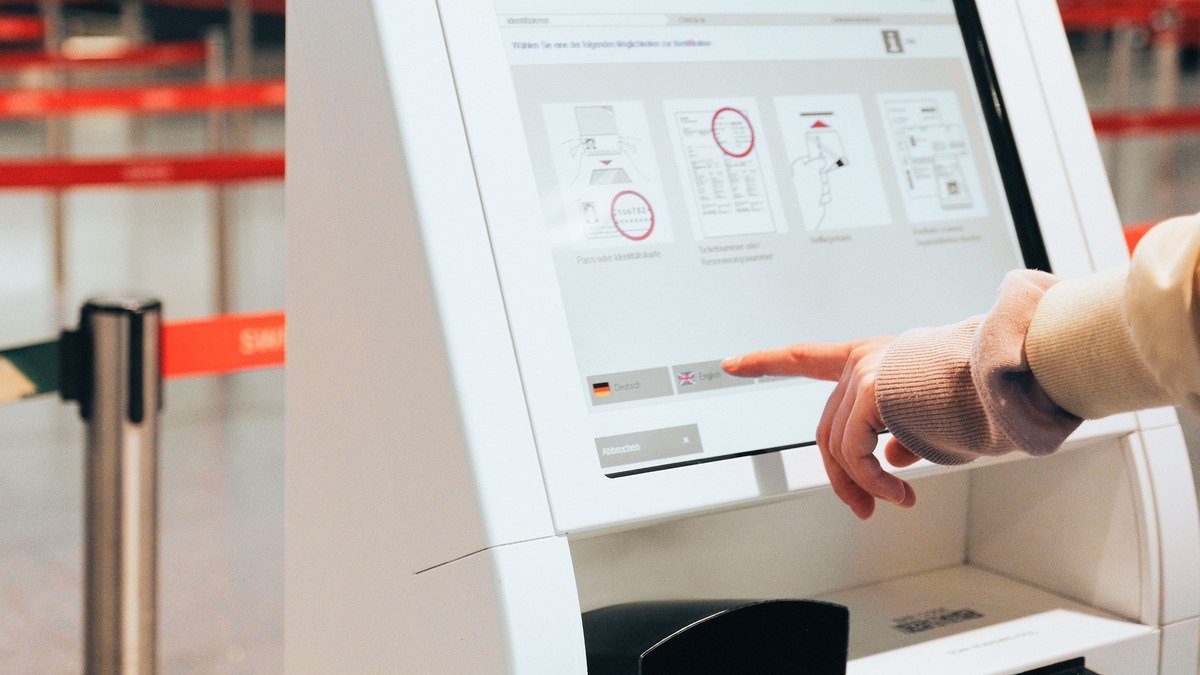
Always-on connectivity for the self-service kiosks nobody is watching.
Single-SIM zero-touch deployment, multi-carrier failover, and full remote management for every ordering terminal, ticketing kiosk, and self-checkout in your fleet. Visible in one console. No truck rolls.
Kiosks are uniquely vulnerable because there's no human nearby to notice or respond to a connectivity failure. These are the specific operational and reputational risks every kiosk operator should be planning against.
01 · Queue & reputation
When a kiosk goes offline in a busy location, the queue builds, and the blame lands on the business, not the SIM provider.
Customers don't know your carrier. They know your logo. A 20-minute outage at lunch in a busy lobby costs you the order and the customer relationship behind it, long after the device is back online.
15sLinQView polls every kiosk every 15 seconds. Your team knows a device dropped before the queue builds
02 · No on-site IT
Outages go undetected for hours unless there's real-time monitoring
There's no manager glancing at the terminal, no cashier waving you down. Without a live heartbeat from every kiosk, you find out about downtime from a customer complaint, and by then revenue is already gone.
real-time monitoring · live heartbeat03 · PCI scope
Payment kiosks carry the same PCI compliance requirements as POS terminals.
If your kiosk accepts cards, the connectivity path should be documented as part of the payment environment.
Physical environments demand industrial-grade SIM hardware, not consumer-grade.
A removable SIM in an outdoor enclosure is a single point of failure waiting to happen. Soldered, sealed, temperature-rated hardware is the only honest answer for unattended devices in the real world.
industrial-grade · soldered & sealed
02KIOSK-NATIVE CONNECTIVITY
NuvoLinQ keeps kiosks online. Automatically. Without a site visit.
Every connectivity decision in the SIM is tuned for unattended operation. From hardware form factor to network policy, the kiosk just keeps running while the platform handles the rest.
Automatic carrier failover that reduces the chance the customer experiences an outage.
If the primary carrier signal degrades, the kiosk can reconnect through a standby carrier to reduce order interruption risk. It's the difference between a kiosk that's "up" and a kiosk that's actually earning.
0 ms250 ms · auth window
< 200 msP99 silent failover, carrier failover at the device/connectivity layer, well inside the transaction-auth window.
01
MFF2 / MFF4 industrial SIM form factor
Soldered directly to the board. No removable SIM, no physical failure point, rated for -40 to 85°C. Built for outdoor enclosures, not phone cases.
-40 / 85°Cop range
02
Self-healing carrier reconnect
Lost link comes back with exponential backoff tuned for kiosks, not phones. No human reset, no morning queue at the help desk.
0human resets
03
Real-time monitoring via LinQView
Know the moment a kiosk loses signal, before any customer does. Live heartbeat, fleet-wide presence, near real-time visibility.
15 sheartbeat
04
ScanLinQ field workflow
Maintenance staff scan the kiosk QR to log a support ticket with full device context attached, no phone call, no triage on hold.
scan → ticketin seconds
05
Private APN + static IP
For payment-accepting kiosks, PCI-grade isolation. Dedicated APN, static IP per device, IP-whitelistable end to end.
PCI scopepayment-accepting kiosks
03Where Kiosks Operate
Every unattended environment your team is responsible for.
Kiosks appear across many industries. The breadth of environments helps you spot your own, same SIM, same console, same reliability underneath every one of them.
01
Retail checkout & returns
Self-checkout lanes and returns kiosks. Multiple devices per store, scaled across many locations, on a shared WAN you can't take down.
Every kiosk. Every signal. Alerts before many issues become support calls.
A kiosk-tuned LinQView: fleet map with live status, automated alerts when a kiosk drops, remote OTA at scale, and usage reporting to spot anomalies before they become outages.
Fleet console · LinQView
Kiosk fleet · North America · 7,820 devices
Live
Online
7,820
↑ 99.99% uptime · 30d
Alerts open
11
3 degraded · 8 watch
Fleet uptime · 90d
99.99
%
↑ within SLA
Automated alerts · last 30m
SessionsFailovers
K-2049-LAXOrdering kioskVerizonOnline
K-0871-ORDParking terminalAT&TFailover
K-3310-YYZTransit ticketingT-MobileOnline
Fleet map · live status per kiosk
Every kiosk location with online / offline / degraded state visible at a glance. Spot offline units immediately, no spreadsheet reconciliation.
Automated alerts when a kiosk drops
Email, SMS, or in-dashboard flag, routed to the right ops team the moment a device misses its heartbeat. No customer call needed to find the outage.
Remote OTA updates · fully remote
Push supported config changes, profile swaps, and eligible firmware updates to any kiosk, one device, one region, or the entire fleet. Staged, monitored, rollback-capable.
Usage reporting & anomaly flags
Track data usage by kiosk, region, carrier, and time period to spot abnormal consumption before it becomes a billing or outage issue.
05Proven in the field
Outcomes from real unattended fleets.
Real fleets, real environments, real uptime. If your team owns unattended hardware, these are the outcomes to expect.
With NuvoLinQ, we feel like we have a partner that always has a solution. The experience has been exceptional. Our teams are thankful for the support, the fast shipping, product availability, and zero connectivity issues. LinQView has been a game-changer for our Deployment and Technical Support teams.
MPMaverick PaymentsPAYMENT PROCESSING PARTNER
“
NuvoLinQ, as our global wireless partner, has enabled us to recognize IoT patterns that are crucial to managing our business. NuvoLinQ's IoT data connectivity lets us process efficiently, securely and cost effectively. As we expand our Dealer network, we look forward to doing so in partnership with NuvoLinQ.
RWRichard WorrallPRESIDENT · CONNECT2GO
“
NuvoLinQ offers us wireless technology solutions at our pumps that make for a seamless installation. The network provides access to both Rogers and Bell, connecting to the strongest signal, so there is never a worry about connectivity.
ECEcoTank CanadaUNATTENDED FUEL & RETAIL
“
NuvoLinQ and its evolutionary, GSMA-approved eSIM allow us to offer our merchants an ‘always on’ posture across North America. The multi-carrier eSIM lets the PSP or the end client choose the best available carrier and switch networks if needed, all on a highly secure private backbone.
DGDanny GurizzanPRESIDENT & CEO · PSP SERVICES
→ Kiosk rollout
Ready to bring your kiosk fleet online?
Read EcoTank's story, or tell us about your footprint for a concrete rollout plan.
Payment processors, fuel retail, vending, security, and connected-device operators across North America
06Frequently asked questions
Questions buyers and assessors ask about Self-Serve Kiosk Connectivity.
Straight answers, no sales call required. Every claim here is the same one we make in the contract.
What connectivity does an unattended self-service kiosk need?
An unattended kiosk needs always-on multi-carrier cellular connectivity with automatic failover, real-time monitoring, and remote management, because no one on site will notice a dropped link. NuvoLinQ pairs a single eSIM with standby carrier failover, a 15-second LinQView heartbeat, remote OTA updates, and a private APN with static IP for payment-accepting kiosks. No truck rolls required.
What is an MFF2 industrial SIM and why does a kiosk need one?
An MFF2 (or MFF4) industrial SIM is an embedded eSIM soldered directly to the device board rather than a removable SIM card. It has no physical failure point and is rated for -40 to 85°C, which suits outdoor enclosures such as parking terminals and EV charging stations. A removable consumer-grade SIM in an outdoor enclosure is a single point of failure.
How fast does carrier failover happen on a payment kiosk?
Carrier failover on NuvoLinQ kiosks completes in under 200 ms at P99, well inside the 250 ms transaction authorization window. The switch happens silently at the device and connectivity layer, so the kiosk reconnects through a standby carrier when the primary signal degrades and the customer's order is less likely to be interrupted. Reconnects use exponential backoff tuned for kiosks and require zero human resets.
Do payment kiosks fall under PCI compliance?
Yes, payment kiosks carry the same PCI compliance requirements as POS terminals, so if a kiosk accepts cards the connectivity path should be documented as part of the payment environment. NuvoLinQ provides PCI-grade isolation for payment-accepting kiosks through a dedicated private APN and a static IP per device, IP-whitelistable end to end, on a PCI-compliant network.
How is a multi-carrier eSIM different from a single-carrier SIM for kiosks?
A multi-carrier eSIM can reconnect through a standby carrier when the primary signal degrades, while a single-carrier SIM has no alternative network when its one carrier drops. NuvoLinQ's LinQ1Zero is a GSMA SGP.32 eUICC backed by direct Tier-1 carrier agreements, not roaming, with Rogers, Bell, AT&T, T-Mobile, and Verizon among its eight North American carriers. EcoTank replaced unreliable carrier connections with it and reduced POS downtime.
How do I know a kiosk has gone offline when nobody is on site?
LinQView polls every kiosk every 15 seconds and raises an automated alert by email, SMS, or in-dashboard flag the moment a device misses its heartbeat. A fleet map shows online, offline, and degraded state per kiosk at a glance. Maintenance staff can scan the kiosk QR with ScanLinQ to open a support ticket with full device context attached.
07get started
Ready to bring your kiosks online?
Get a connectivity assessment built around your unattended fleet. We map what you run, find the right deployment, and hand you a concrete plan. No on-site IT required.
NuvoLinQ keeps self-service kiosks online across North America on a private wireless backbone with a 99.99% uptime SLA, with zero on-site technical presence required.